THE TWIN BRIEF
Smashed idols, a smuggled box at Egyptian customs, a giant with a hidden agenda, and the night sky as a promise. This week: the reading, three midrashim retold, a longer Dvar from the Ben Ish Chai on the world’s laziest excuse-maker, practical Sephardi halacha for the Shabbat table, and full Bronx zmanim. About a 10-minute read. Illustrated. Open the printable version →
This Week’s Reading
Parashat Lech Lecha — Genesis 12:1–17:27
- Parasha: Lech Lecha, Genesis 12:1–17:27
- Maftir: Genesis 17:24–27
- Haftarah: Isaiah 40:27–41:16, “Lamah tomar Yaakov.” Sephardim and Ashkenazim read the same haftarah this week. It mentions “who stirred up one from the east” (41:2), which Rashi reads as Avraham.
- No special Shabbat this week.
Teen summary: Hashem tells Avram: leave your land, your birthplace, and your father’s house, and go “to the land I will show you.” No map, no address. He goes. A famine sends him and Sarai down to Egypt, where Pharaoh takes Sarai and gets hit with plagues until he gives her back. Avram and his nephew Lot split up (Lot picks Sodom, not a great real-estate call). Four kings beat five kings and capture Lot, so Avram takes 318 men, wins, and then refuses to keep even “a thread or a shoelace” of Sodom’s loot (14:23). Hashem shows him the stars and promises children beyond counting, then makes the Brit bein HaBetarim, the covenant between the pieces, including a warning that his descendants will be strangers in a foreign land for 400 years. Hagar has Yishmael. At 99, Avram becomes Avraham, Sarai becomes Sarah, and Avraham does the brit milah.
Parasha Stories
Three midrashim for teens
1. “The big idol did it”
Before any of this, Avram’s father Terach sold idols. Bereshit Rabbah 38:13 says that one day Terach left young Avram in charge of the store. A customer walks in. Avram asks, “How old are you?” “Fifty, sixty.” “Wow. A sixty-year-old bowing to something made yesterday?” The customer leaves, embarrassed. Then a woman brings a plate of flour as an offering. Avram grabs a stick, smashes every idol, and puts the stick in the hand of the biggest one.
Terach comes back: “WHO did this?” Avram: “A lady brought flour, they all fought over who eats first, and the big one got up and smashed the rest.” Terach: “Are you mocking me? They can’t do anything!” Avram: “Do your ears hear what your mouth is saying?”
Terach hands him over to King Nimrod, who says, “Bow to fire.” Avram: “Why not water? It puts out fire.” “Fine, water.” “Why not clouds? They carry water.” “Fine.” “Why not wind? It scatters clouds.” “Fine.” “Why not people? They stand up to wind.” Nimrod loses patience and throws him into a fiery furnace. Avram walks out. His brother Haran had been waiting to see who wins before choosing a side. When he finally says “I’m with Avram,” he’s thrown in too, and he doesn’t survive.
Teen take: logic beats a crowd. And waiting to see which side is winning before you stand for something isn’t really standing for anything.
2. The box at customs
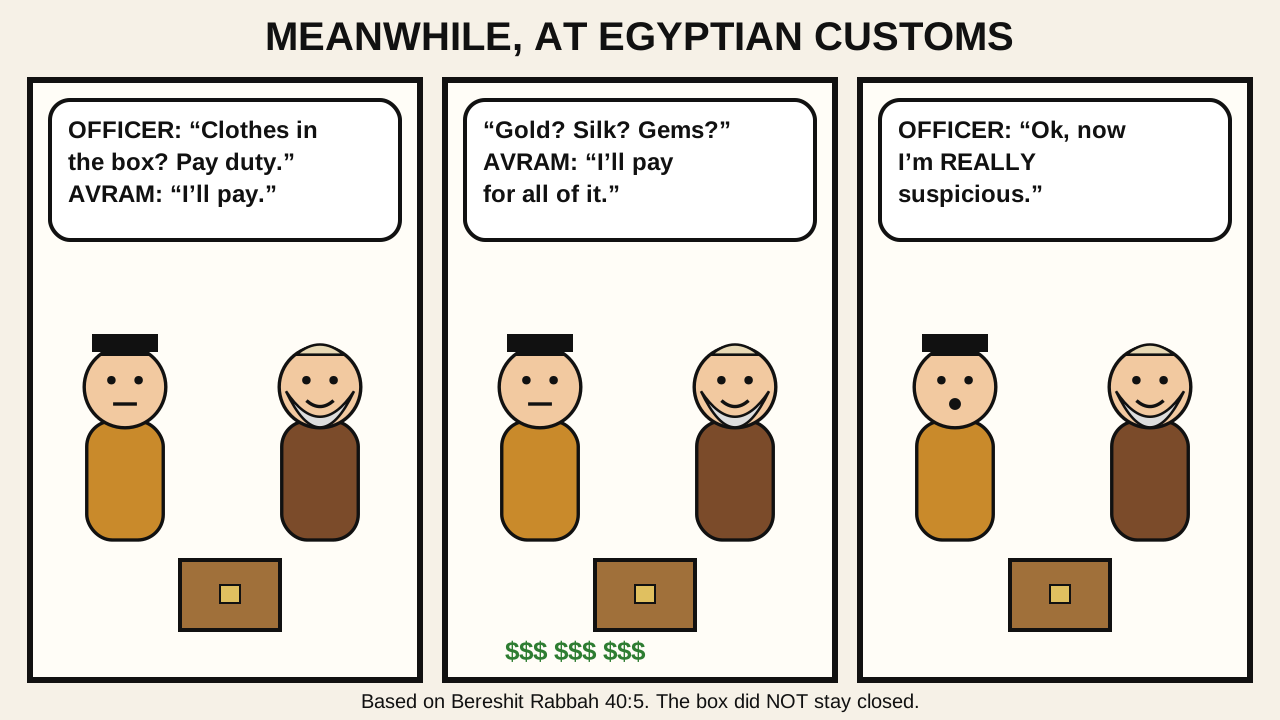
When Avram enters Egypt, the Torah says “the Egyptians saw the woman,” but it only mentions Avram arriving. So where was Sarai? Bereshit Rabbah 40:5: he locked her in a chest. At the border, the customs officers say, “Pay the duty.” “Sure, I’ll pay.” “Clothes in there?” “I’ll pay for clothes.” “Gold?” “I’ll pay for gold.” “Silk?” “I’ll pay for silk.” “Gems?” “I’ll pay for gems.” Naturally, now they’re sure something is up, and they insist on opening it. When they do, the Midrash says, all of Egypt lit up from Sarai’s beauty.
Teen take: sometimes the person working hardest to look chill is the most suspicious one in the room. And Avram really did try everything to protect his family.
3. The “helpful” giant
After Lot is captured, “the refugee came and told Avram” (14:13). Who was this escapee? Bereshit Rabbah 42:8 says it was Og, the giant (yes, the same Og that Moshe fights centuries later). His plan wasn’t to help. He figured Avram was a zealot who would rush into battle, get killed, and then Og could take Sarai. Hashem’s response: you’ll get a reward for the steps you walked to deliver the news, so you’ll live a very long time. But because you wanted that tzaddik dead, you’ll live to see his countless descendants, and in the end you’ll fall into their hands.
Teen take: doing the right thing for the wrong reason still counts a little, but Hashem sees the whole motive. Be the friend who actually wants good things for people.
Dvar Torah
The Lion in the Hallway
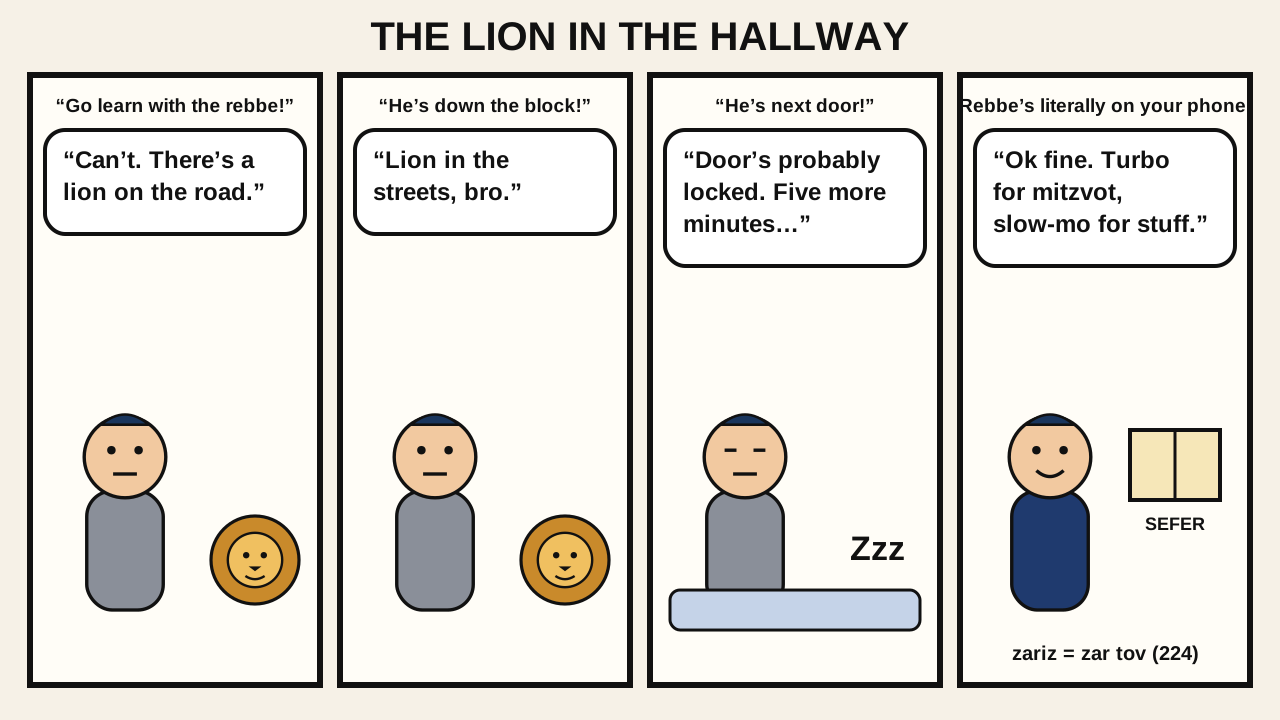
“V’Avram kaved me’od bamikneh bakesef uvazahav” (13:2). Usually that means “Avram was very rich in cattle, silver, and gold.” But kaved literally means heavy. The Ben Ish Chai, the great Sephardi Torah giant of Baghdad, reads it that way. Avram was famous for speed when Hashem asked for something: he left right away (12:4), and at the Akeidah he got up early in the morning. So you might think he was just a fast guy, quick at everything. Nope. With money and stuff, Avram moved heavy. He didn’t chase it. Turbo for mitzvot, slow-mo for stuff.
He brings the Chida on “Go to the ant, you lazy one” (Mishlei 6:6): learn speed from the ant, but spend that speed on Torah and good things, not on chasing stuff that doesn’t last.
Then he quotes a Midrash (Devarim Rabbah 8:6) that is basically the funniest roast of a lazy person ever written. Shlomo HaMelech describes the lazy guy in seven steps. They tell him, “Your rebbe is in town, go learn!” He says, “There’s a lion on the road.” “He’s in the middle of the city!” “There might be a lion in the streets.” “He lives right next to you!” “The lion’s outside.” “He’s in your building!” “What if the door is locked?” “It’s open!” “Okay, open or locked, I just want five more minutes of sleep.” They put food in front of him, and he’s too lazy to lift it to his mouth. And number seven: Rabbi Shimon bar Yochai says it’s the person who doesn’t learn Torah when he’s young, wants to learn when he’s old, and can’t.
The Ben Ish Chai notices something sharp. That same lazy guy is fast at plenty of physical things. So it can’t be his nature. Laziness only about holy things is the yetzer hara talking, not your personality. (Think about who suddenly can’t get out of bed for minyan but is wide awake at 6 AM for a new sneaker drop.)
Then he says the “too lazy to eat” line is about his own generation. Long ago, Torah was memorized mouth to mouth. Then handwritten books, super expensive. Then printing, still pricey. Then cheap printing. Then compilers who organized everything and added indexes, so you can find any halacha with zero effort. His line: the earlier generations plowed, planted, harvested, ground, kneaded, baked, cooked, and set it all on the table in front of us, and we’re too lazy to put it in our mouths. He wrote that about indexes in the 1800s. Imagine him seeing every sefer free on your phone.
And step seven is your step. Things that are hard when you’re old become easy if you trained them when you were young, because habit turns hard things into nature. That’s how he reads King David: “Chashti v’lo hitmahmahti,” I hurried and didn’t delay to keep Your mitzvot (Tehillim 119:60). Even old, David could hurry, because he never delayed when he was young. Fifteen is the training window.
Two bonus points. Zariz (quick) has the same gematria as zer tov, a good crown (224). And the root of speed is simcha: whatever you’re happy about, you do fast. Joy is the mother of zerizut.
Teen takeaway: turbo for mitzvot, slow-mo for stuff. And when you notice yourself dragging your feet on something good, don’t blame the lion in the hallway. Ask whether you’ve found the joy in it yet.
Source: Ben Ish Chai, Halachot 2nd Year, introduction to Parashat Lech Lecha (Hebrew checked on Sefaria), quoting the Chida on Mishlei 6:6 and Devarim Rabbah 8:6; Bereshit 13:2, 12:4; Tehillim 119:60. Written in-house for teens. Teen reference, not a personal ruling.
Practical Halacha · Sephardi / Shulchan Aruch / Yalkut Yosef
This Shabbat’s checklist
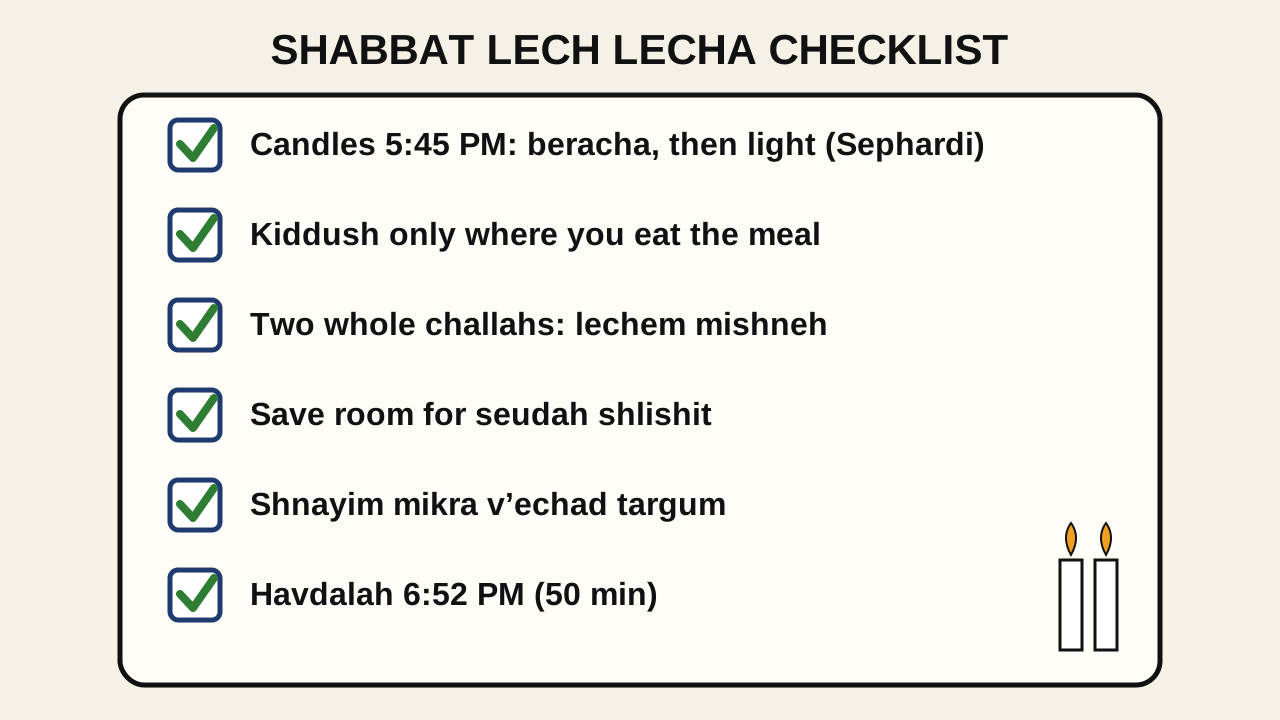
- Candles, beracha first: the Shulchan Aruch says to make the beracha “l’hadlik ner shel Shabbat” when lighting (OC 263:5), and Sephardi practice, as Yalkut Yosef rules, is to say the beracha and then light. The “light first, cover your eyes, then bless” method is the Rema’s Ashkenazi custom in the same se’if. Candles this week: 5:45 PM.
- Kiddush where you eat: “Ein Kiddush ela b’makom se’udah,” Kiddush only counts where you eat the meal (OC 273:1). Moving from one corner of the same room to another is fine. Don’t make Kiddush in the living room and then go eat at a friend’s house.
- Lechem mishneh: hold two whole loaves and cut the bottom one (OC 274:1). Whole means whole, so no pre-sliced challah standing in for loaf #2.
- Seudah shlishit: be very careful to eat the third meal. Even if you’re full, a kebeitzah (about an egg’s worth) of bread does it. The Shulchan Aruch adds a line that sounds like it was written for Shabbat lunch: a wise person doesn’t stuff himself at the morning meal, so there’s room for the third (OC 291:1).
- Shnayim mikra v’echad targum: even though you hear the whole parasha in shul, you review it yourself, twice in Hebrew and once in Targum, “even Atarot v’Divon,” meaning even the list-of-places pesukim (OC 285:1). Lech Lecha has a whole war chapter full of names, so: even Kedorlaomer.
- Havdalah, sitting: the Shulchan Aruch says Havdalah is said sitting (OC 296:6). The Rema notes the Ashkenazi custom to stand. Shabbat ends at 6:52 PM (50 min).
Teen reference only, not personal psak. Ask a rav for your household.
Zmanim · Bronx NY 10471 · ET
Full Shabbat times
Fri Oct 23 · Erev Shabbat Lech Lecha / 12 Cheshvan
- Candle lighting: 5:45 PM
- Sunset: 6:03 PM (candles 18 min before)
Sat Oct 24 · Shabbat Lech Lecha / 13 Cheshvan
- Sunrise: 7:17 AM
- Latest Shema: 9:22 AM (Magen Avraham) / 9:58 AM (Gra)
- Latest Tefillah: 10:28 AM (MGA) / 10:52 AM (Gra)
- Chatzot: 12:39 PM
- Mincha gedola: 1:06 PM
- Plag hamincha: 4:55 PM
- Sunset: 6:02 PM
- Shabbat ends / Havdalah: 6:52 PM (Hebcal Bronx, 50 min)
Calendar FYI
- Keep saying mashiv haruach u’morid hageshem. V’ten tal u’matar (Diaspora) starts at Maariv Fri night Dec 4, 2026.
- Next week: Parashat Vayera · candles Fri Oct 30 5:35 PM · Havdalah Sat Oct 31 6:43 PM (50 min)
Times from Hebcal for Bronx 10471 (America/New_York). Havdalah at 50 minutes per household practice. Confirm with your community custom.
Illustration
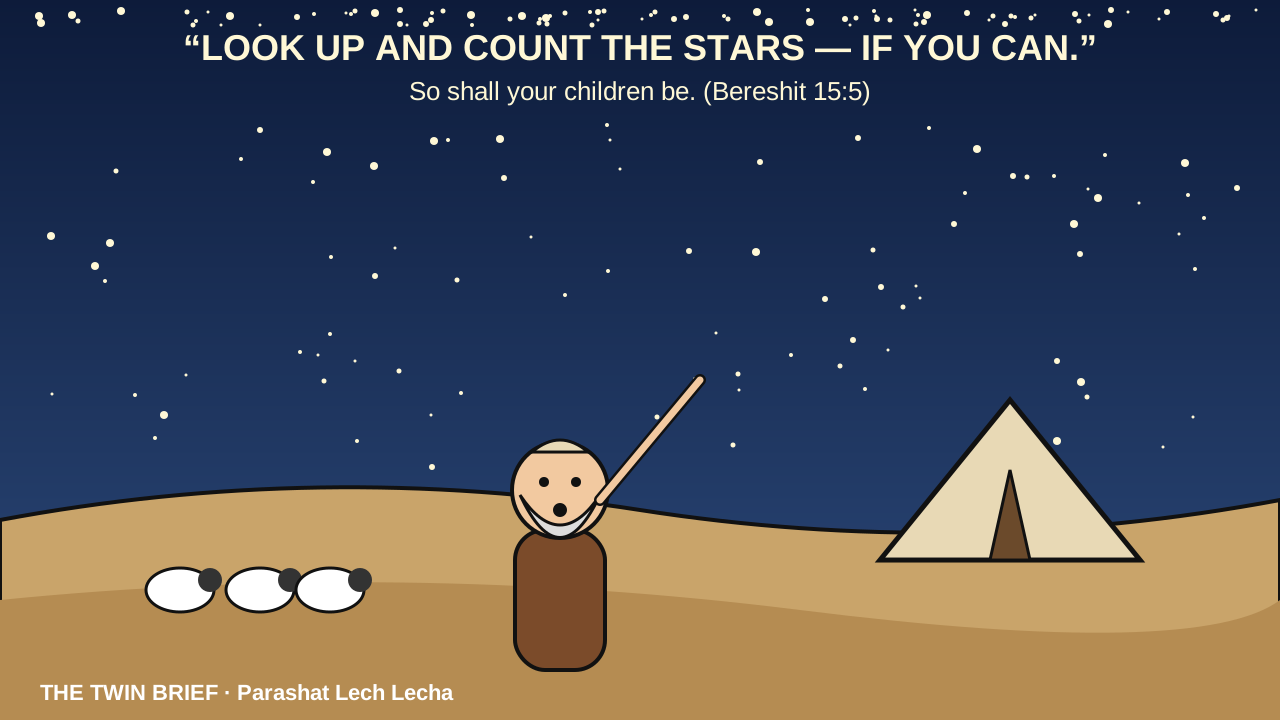
Count the stars
Closing Comic
Meanwhile, at Egyptian customs
Prefer paper? Print this edition (letter size, B&W-friendly)